


If you spend enough time on Ottawa-area trails with a dog, a porcupine encounter is almost a rite of passage, and rarely a happy one. The Greenbelt and Gatineau Park have healthy porcupine populations, dogs are curious, and the result is a face full of quills and a very distressed pet. Your instinct will be to start pulling them out. This article is mostly about why you shouldn’t, and what to do instead.
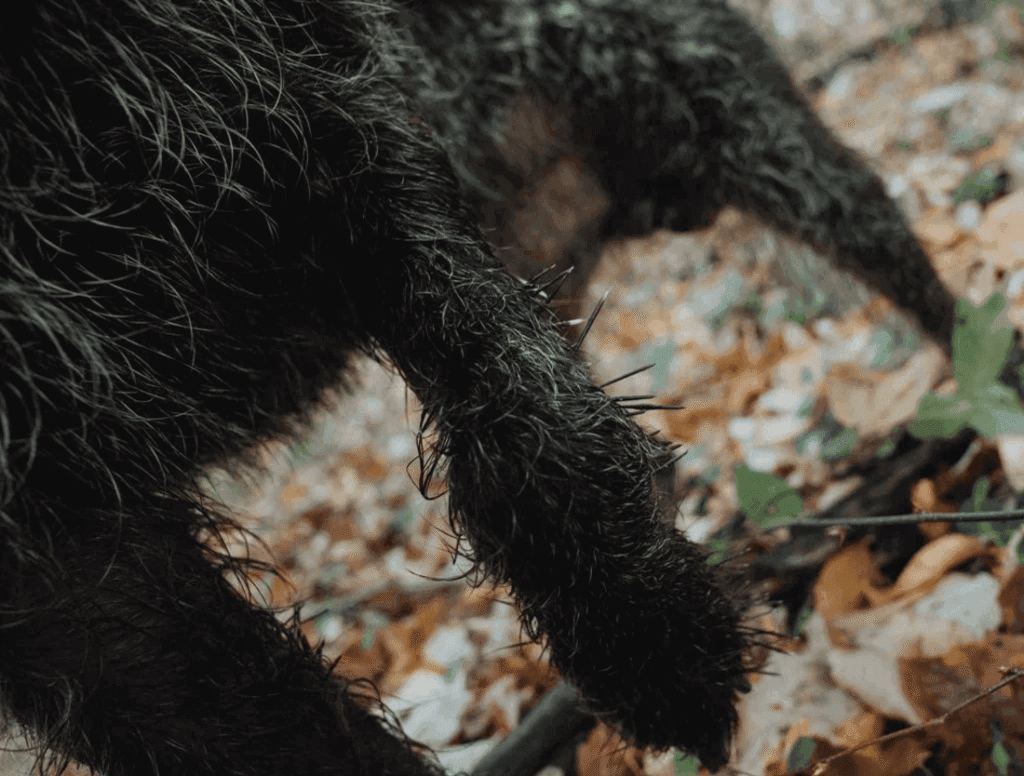
How porcupine quills actually work
First, a myth worth retiring: porcupines don’t throw or shoot their quills. The quills detach on contact when a dog presses into them. Each quill is tipped with microscopic, backward-facing barbs (like a fish hook) that catch the surrounding tissue. Those barbs are the whole problem. They’re designed by nature to resist being pulled out, and they make quills work their way deeper rather than back out on their own.
Body heat and muscle movement cause embedded quills to slowly advance inward over time. This is why a quilling is never just a surface problem.
Why you shouldn’t pull quills at home
It’s tempting, especially if there are only a few. But home removal goes wrong in several predictable ways:
- Quills break easily. Pulling at the wrong angle or on a panicked dog snaps the quill, leaving the barbed tip buried where you can’t see or reach it.
- Broken-off pieces migrate. A fragment left under the skin doesn’t stay put. It travels through tissue, and quills can migrate into joints, the chest, and even toward vital organs over days to weeks.
- You’ll miss the ones that matter most. The dangerous quills are often inside the mouth, on the tongue, at the back of the throat, and around the eyes — places you can’t safely examine in a struggling, painful dog.
- It’s agonizing for the dog. Quill removal hurts a lot. A dog in that much pain may bite, even a gentle one, and the struggle drives remaining quills deeper.
- You won’t get them all. Dogs are frequently hit with dozens to hundreds of quills. Thorough removal in an awake, distressed animal simply isn’t realistic.
The migration risk
This is the part owners underestimate most. Even if you pull every quill you can see, any tip that breaks off and stays behind can keep moving through the body. Migrating quill fragments cause abscesses, deep infections, and sometimes serious damage when they reach a joint, the chest cavity, or other structures, sometimes weeks after the original encounter, long after everyone thought the problem was solved.
That delayed timeline is exactly why proper removal matters from the start. It’s far easier to remove quills cleanly and completely while they’re fresh than to chase migrating fragments later.
What you should actually do
If your dog gets quilled:
- Keep your dog as calm and still as possible. Excitement, pawing at the face, and rubbing on the ground all drive quills deeper.
- Stop them from pawing at their face or rubbing on the ground if you can do so safely.
- Don’t cut the quills. There’s an old belief that snipping quills “deflates” them and makes removal easier. It doesn’t, and it makes the quills harder to grip and more likely to splinter.
- Don’t attempt full removal yourself, especially anything near the eyes, mouth, or throat.
- Get to a vet promptly. The sooner quills are removed, the easier and more complete the removal, and the lower the chance of migration and infection.
How vets remove quills safely
Proper quill removal almost always requires sedation or general anesthesia, and there’s a good reason for that. A sedated dog feels no pain and stays still, which lets the vet remove each quill at the correct angle, methodically check the harder-to-see areas inside the mouth, the tongue, around the eyes, and make sure nothing is left behind to migrate later. It’s far more thorough than anything achievable on an awake animal, and it spares your dog a genuinely traumatic experience.
Quills near or in the eye are treated as especially urgent, since they can threaten vision. The same goes for quills affecting the mouth and throat, which can interfere with eating and breathing.
FAQ
There are only a few quills. Can I just pull those out myself?
Even a few quills carry the risk of breaking and leaving migrating fragments, and a few visible quills can mean others are hidden in the mouth or elsewhere.
Will the quills come out on their own if I leave them?
No, and that’s the danger. Because of the barbs, quills move inward, not outward. Leaving them in place risks migration, infection, and abscesses rather than a natural resolution.
How urgent is it, really?
Same-day urgent. The longer you wait, the deeper quills settle, and the harder removal becomes. Prompt care makes the whole process easier and safer.
My dog has been quilled before with no problem. Why bother with the vet this time?
Every quilling is different, and getting lucky once doesn’t change the underlying risk of breakage and migration. Hidden or broken quills can cause problems even when an encounter seems minor on the surface.
Did your dog tangle with a porcupine?
Let us remove them safely and completely. Walk in to Galaxy Vets Urgent Care & Walk-In: Ottawa at 21 Jamie Avenue.
Open every day, noon to midnight.